GSTAT Upholds Profiteering of Rs 13.61 Crore by Not Passing GST Rate Cut Benefit to Consumers
GSTAT Upholds Profiteering of Rs 13.61 Crore by Not Passing GST Rate Cut Benefit to Consumers
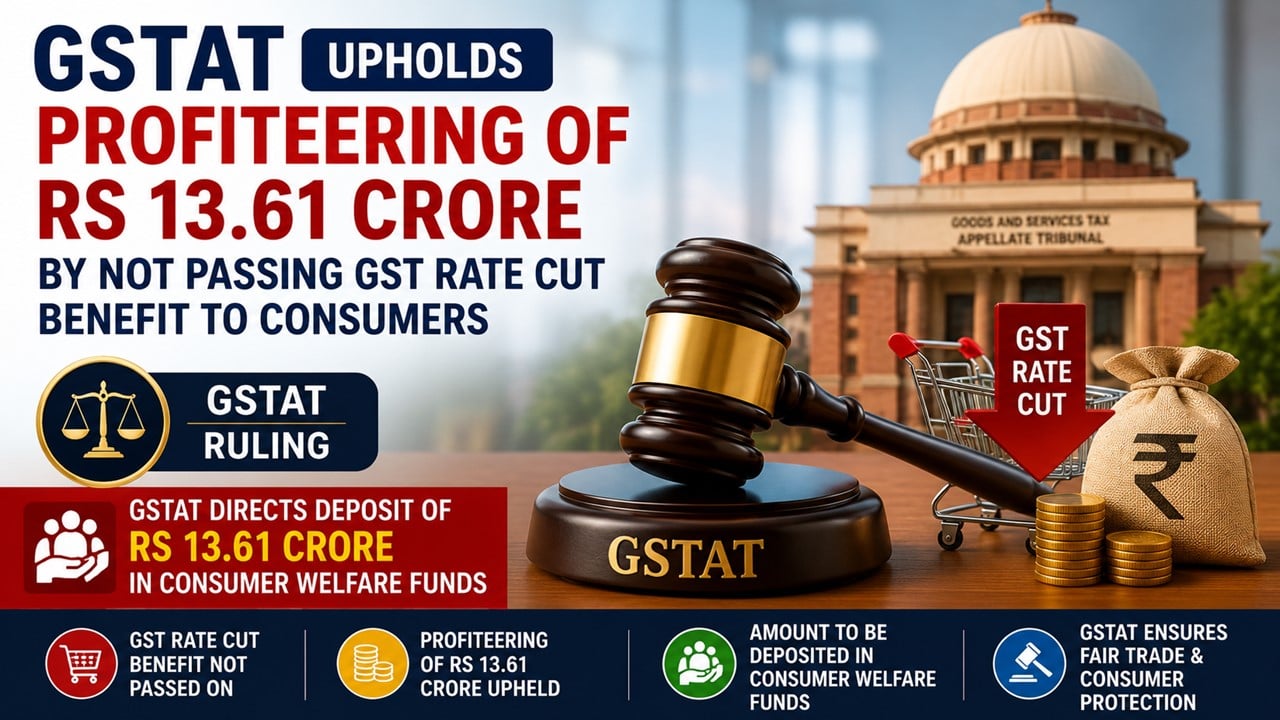
The Goods and Services Tax Appellate Tribunal (GSTAT) held that Lifestyle International Pvt. Ltd. has violated Section 171(1) of the CGST Act, as it has not passed on the benefit of the GST rate reduction to consumers. The complainant had purchased a cosmetic product from the respondent, and the selling price remained unchanged even after reduction in GST. The proceedings originated from a complaint that said that Lifestyle International Pvt. Ltd. failed to pass on the benefit of the GST rate reduction on certain products after the GST Council reduced the tax rate on several FMCG items from 28% to 18% with effect from 15 November 2017. After the complaint, the Directorate General of Anti-Profiteering (DGAP) conducted an investigation.
During the investigation it was found out that there was profiteering in the said product. Subsequently, the matter was expanded for further investigation covering a larger range of products sold by the company across the country. After re-investigation, DGAP concluded that the respondent had increased the base prices of affected products despite the reduction in GST rates, which led to the retention of tax benefits from reaching the customers.
The respondent challenged the proceedings on several grounds, including that the National Anti-Profiteering Authority (NAA) lacked jurisdiction to expand the scope of investigation beyond the original complaint and that the proceedings were barred by limitation. Also, it was contended that the methodology adopted by DGAP for computing profiteering was flawed and arbitrary.
The Tribunal rejected the jurisdictional challenge and held that the anti-profiteering authorities possessed sufficient power to direct further investigation where facts warranted deeper examination. The Tribunal further held that omission of rules relating to the constitution and functioning of the erstwhile NAA did not invalidate pending proceedings.
The Tribunal found that the reduction of the GST rate from 28% to 18% is already proven, but the respondent is not able to establish that the tax reduction benefit had been passed on to consumers through a reduction in prices. Accordingly, the Tribunal accepted DGAP’s findings and directed the respondent to deposit the entire profiteered amount of Rs 13.61 crore into the Consumer Welfare Funds, with Rs 6.80 crore each to be deposited in the Central Consumer Welfare Fund and the respective State/UT consumer welfare funds.